
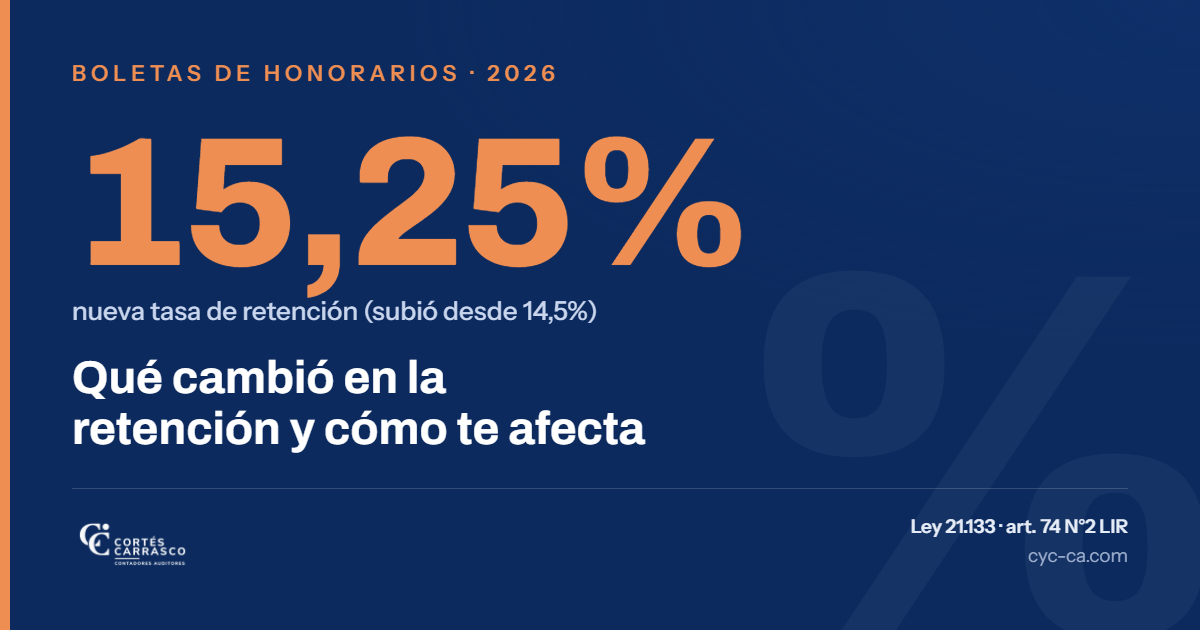
Si emites o recibes boletas de honorarios, 2026 trae un cambio que conviene tener claro: la retención subió a 15,25%, según el calendario gradual que fijó la Ley 21.133. No es un impuesto nuevo, pero sí cambia cuánto se descuenta hoy y cómo se ajusta en tu declaración anual.
Publicado el 23-07-2026 · Actualizado el 25-08-2026 · Por Claudio Cortés Ríos, Contador Auditor, Magíster en Tributación
In brief
The withholding is neither a new tax nor an extra cost: it is an advance payment settled in the annual return, and it is rising under a phased timetable already set back in 2019. What changes in practice is the monthly cash flow of whoever issues the receipt, not the final tax they end up paying.
- Why is the withholding on fee receipts going up?
- How much is withheld in 2026?
- Who is affected?
- The impact on your annual return (Operación Renta)
- Practical recommendations
- Frequently asked questions
- In summary
Why is the withholding on fee receipts going up?
Since Law 21,133 (2019), those who issue professional-fee receipts became required to contribute to pension (AFP), health (Fonasa or Isapre), the disability-and-survivorship insurance, and workplace-accident insurance. To fund those contributions without the independent worker having to pay everything at once in April, the monthly withholding increases gradually each year until it stabilizes. In practice, a little more is withheld from each receipt every year.
How much is withheld in 2026?
As of 01-01-2026 la retención es de 15,25% of the gross amount of the receipt (up from 14.5% in 2025). It is a Second-Category withholding (art. 74 N° 2 de la LIR): la declara y entera quien paga la boleta. El calendario definido por la ley:
| Year | Withholding rate | Neto que recibe el emisor |
|---|---|---|
| 2025 | 14,5% | 85,5% del bruto |
| 2026 | 15,25% | 84,75% del bruto |
| 2027 | 16% | 84% del bruto |
| 2028 | 17% (final) | 83% del bruto |
Example: on a receipt of MM$1 ($1.000.000), se retienen M$152,5 ($152.500) y el emisor recibe M$847,5 ($847.500) netos. Ese monto retenido is not lost: it is credited toward your contributions and taxes in the annual return (Operación Renta).
You can confirm the rate in force in the SII's Professional-Fee Receipts section.
Who is affected?
| Quién paga la boleta | ¿Retiene? | Quién declara en el F29 |
|---|---|---|
| Empresa o contribuyente obligado | Sí, 15,25% | El pagador, como agente retenedor |
| Persona natural sin giro | No | El propio emisor, como PPM en su F29 |
- If you issue receipts (a professional or independent worker): you will receive a slightly lower net amount each month, but you advance your contributions and your April return tends to balance out better.
- If your company receives receipts from third parties: you are a withholding agent. You must withhold the 15,25% in force, declare it, and pay it in Form 29 (F29) on time. A mistake here triggers penalties and interest.
Si necesitas ordenar ese Formulario 29 antes de declarar, puedes usar nuestro simulador del Formulario 29, que incorpora esta misma escala de retención.
The impact on your annual return (Operación Renta)
The withholding is an advance payment, not an extra cost. In the Operación Renta it is offset against your mandatory contributions and your final tax. Depending on your situation, it may result in a refund or a balance in your favour or payable: si la retención del año no alcanza a cubrir todas tus cotizaciones, tendrás que enterar la diferencia. La clave es no confundir «me retienen más» con «pago más impuesto»: lo que cambia es when you pay it.
Practical recommendations
- Independent workers: budget on the real net amount (84.75% of the gross in 2026) and check on your SII proposal that contributions are correctly credited.
- Companies: asegúrate de que tu sistema contable esté updated with the 15.25% rate and of reporting the withholding on the right Form 29. And if you also issue VAT-liable invoices, review the e-invoicing mistakes that hit your VAT credit.
- Ante dudas de cómo te afecta según tu caso, conversemos antes de que se acumulen diferencias.
Frequently asked questions
How much is withheld on a professional-fee receipt in 2026?
15.25% of the gross amount, per the schedule of Law 21,133 (up from 14.5% in 2025).
¿Quién hace la retención de la boleta de honorarios?
If the payer is a company or an obligated taxpayer, it withholds, declares, and pays the 15.25% in its F29. If the payer is a natural person without a business activity, there is no withholding and the issuer pays the PPM in their own F29.
¿La retención de honorarios se devuelve?
It is not an extra tax: it is an advance credited toward your contributions and your tax in the Operación Renta. Depending on your case, it results in a refund or a balance due.
¿Por qué sube la retención de honorarios cada año?
Law 21,133 set a gradual increase to fund your contributions as an independent worker: it reaches 16% in 2027 and 17% in 2028 (final rate).
How much do I receive net on a CLP $1,000,000 receipt in 2026?
M$847,5 ($847.500), porque se retienen M$152,5 ($152.500).
In summary
At C&C we help issuers and companies correctly manage their receipts, withholdings, and contributions, and plan ahead so that the Operación Renta brings no surprises. See our tax-compliance and accounting services.
Sources
Normativa
- Ley N° 21.133 de 2019 — incorporación de los trabajadores independientes a la seguridad social y calendario gradual de retención
- Ley sobre Impuesto a la Renta, artículo 74 N° 2 — retención de segunda categoría
- Ley sobre Impuesto a la Renta, artículo 42 N° 2 — rentas de la actividad profesional independiente
Fuentes del SII
- SII — destacado de Boletas de Honorarios, con la tasa de retención vigente
- Formulario 29 — declaración mensual de retenciones y PPM
¿Tienes dudas con tus boletas o retenciones? Talk to us. O escríbenos por WhatsApp.
This article is for information purposes and reflects the rules in force as of August 2026. It is not a substitute for specific advice: each case depends on the taxpayer’s particular circumstances.
Claudio Cortés is founding partner of C&C Contadores Auditores, a Chilean accounting, audit and tax advisory firm. Contador Auditor (Chilean CPA) and Master’s in Taxation, Universidad de Chile. Reviewed by C&C’s tax team. About us · LinkedIn